OBC Fire Separation Rules for Secondary Suites
Last reviewed: May 4, 2026 | Primary sources: Ontario second-unit guide, O. Reg. 332/12 Building Code, City of London ARU rules.
In London, Ontario, secondary suites require a continuous OBC-compliant fire separation between the basement apartment, the main dwelling, common areas, and ancillary spaces before the City will close the ARU building permit. Ceiling height and egress windows get attention because they are easy to measure, but fire separation is the most common inspection failure London landlords underestimate: gaps above beams, unsealed duct penetrations, unrated doors and discontinuous drywall often surface late. That failed inspection can freeze work, trigger a Stop Work Order, and force expensive tear-outs before rental licensing or occupancy can proceed under City review and permit conditions safely.
Quick answer
Fire separation is not a drywall checkbox. It is the full barrier between units and service spaces, and the City will inspect the continuous assembly, penetrations, doors, and smoke-alarm path together.
- Use the triage tool if the inspection already failed.
- Pair this with the 1.95m height guide and egress calculator.
- Document the monthly progress in the reporting pack.
The Plain-English Rule
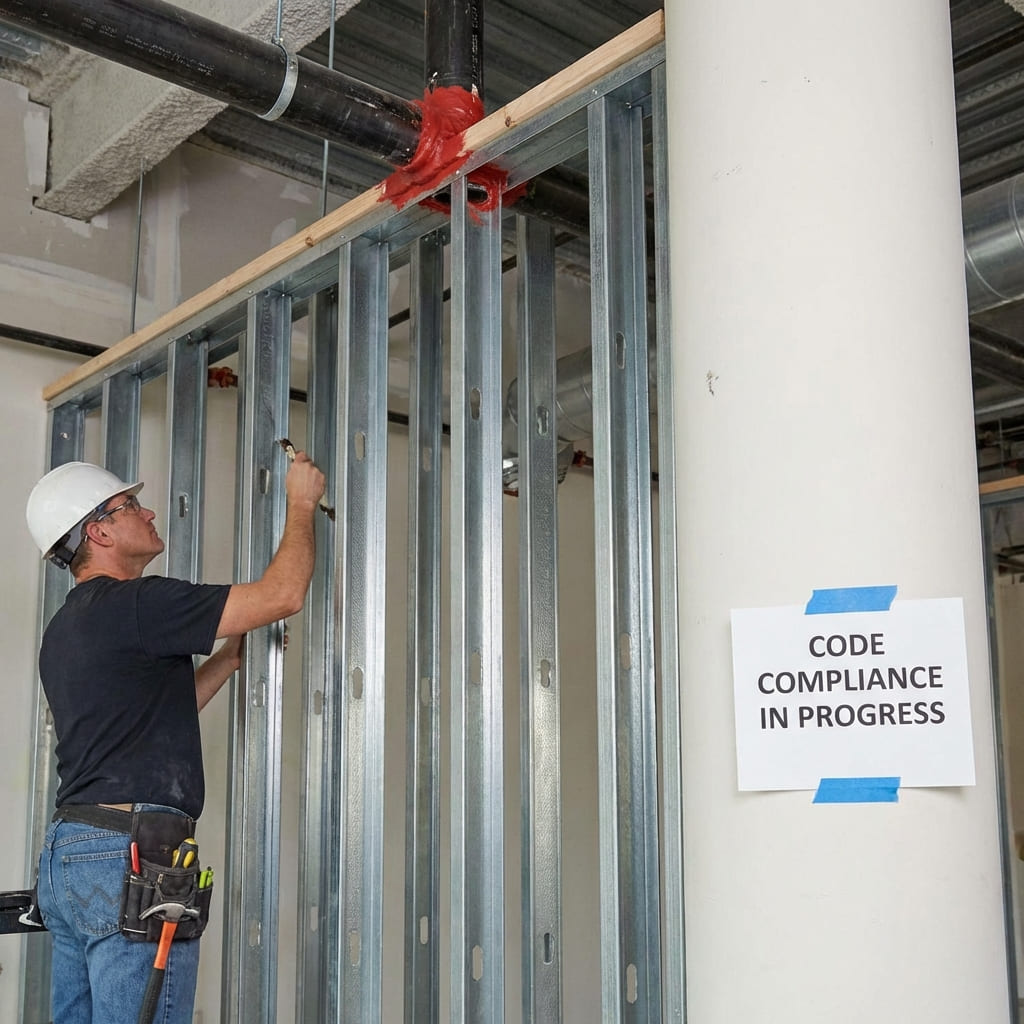
A fire separation is not just drywall. The Ontario guide defines it as a physical barrier that slows fire spread between one part of the house and another. In a basement apartment, that barrier normally includes the ceiling/floor assembly between units, any separating walls, common corridors or stairs, service rooms, doors, and every opening through the assembly.
The word that matters during inspection is continuous. A good-looking basement ceiling can still fail if the fire-rated membrane stops at a bulkhead, is cut open around plumbing, or leaves the rim joist, stair enclosure, furnace room, or duct chase unprotected.
Key OBC Numbers Landlords Should Know
- 45 minutes: Division B, Article 9.10.9.14 is the Part 9 residential-suite fire-separation reference commonly used for new construction or newer homes where a full rated separation is required.
- 30 minutes: Ontario's second-unit guide cites Division B, Table 11.5.1.1.C., Compliance Alternatives 147, 152 and 153 for existing houses where a second unit is added and existing floor or ceiling work is altered.
- 15 minutes: The same Ontario guide says a fire separation can be reduced to 15 minutes where the entire house has interconnected smoke alarms, subject to the accepted permit path.
- 5 years: London tells ARU applicants that houses more or less than five years old are reviewed under different parts of the OBC, and houses less than five years old must have the original building permit closed.
- 15.9 mm or 16 mm: A 5/8-inch Type X gypsum board layer is common in rated ceiling assemblies, but it must be installed as part of a listed or accepted wall, ceiling, or floor assembly.
45-Minute vs. 30-Minute Paths
For investor planning, assume the City will want the drawings to show a 45-minute fire-resistance rating unless your designer is clearly using an accepted Part 11 compliance alternative for an existing house. That assumption is conservative, but it protects budget and sequencing.
A common 30-minute wall example in Ontario guidance uses 38 mm x 89 mm wood studs, 13 mm drywall on both sides, and fibre-type insulation in the cavity. A common 30-minute floor/ceiling example uses 16 mm plywood subfloor, 38 mm x 241 mm joists at 406 mm on centre, 89 mm fibre insulation, and one layer of 16 mm fire-rated drywall on the ceiling side.
A 45-minute design usually means your BCIN designer, architect, or engineer must specify an assembly from the OBC supplementary standards or another acceptable tested assembly. The inspector is not approving the phrase "Type X"; they are approving a complete assembly.
What Type X Drywall Does and Does Not Solve
- Type X board helps because glass fibres in the gypsum core improve fire resistance.
- It does not automatically rate an old ceiling if joist size, spacing, insulation, fasteners, joints, and penetrations are not addressed.
- It does not excuse open duct runs, missing fire stopping, unsealed pipe holes, or unprotected recessed fixtures.
- It does not replace required smoke alarms, carbon monoxide alarms, egress, exits, or rental licensing.
Already facing an inspection note?
A fire-separation deficiency can turn a normal permit correction into an Order to Comply when the suite is already occupied or work was done without inspections. Run the triage first so you know whether the next move is drawings, selective drywall removal, an engineer letter, or a full permit reset.
Launch the Order to Comply TriageLondon ARU Rules That Sit Beside the OBC
Provincial as-of-right rules under Bill 23, the More Homes Built Faster Act, 2022, received Royal Assent on November 28, 2022. The Planning Act changes stop municipalities from using zoning to prohibit small-scale residential intensification on many urban residential parcels, including up to three residential units in a detached, semi-detached, or rowhouse, or a two-plus-one layout with an ancillary building.
London has gone further on eligible properties. Its current ARU page says zoning can permit up to four total dwelling units, with a maximum of three ARUs per lot and no additional parking required for ARUs. It also directs applicants to Zoning By-law Z.-1, Section 4.37 for Additional Residential Units and notes temporary Interim Control By-law CP-1600-300 limits.
- Section 4.37: London's zoning reference for Additional Residential Units.
- CP-1600-300: Temporary London rules limiting an ARU to 80% of the gross floor area of the primary dwelling.
- Two bedrooms per ARU: London's current temporary bedroom cap for each ARU.
- Five ARU bedrooms total: London's current maximum across all ARUs on a property, with location-specific caps for attached and accessory-building ARUs.
- Building permit plus rental licence: London states that a building permit and residential rental unit licence are required for all ARUs.
What Your Permit Drawings Must Show
London's ARU permit checklist requires construction drawings, drawn to scale, that identify fire separations as both existing and new. A single-line sketch is not enough. The drawings should let the plans examiner see how the barrier continues across ceilings, walls, doors, stairs, and service spaces.
- Existing floor plans for all floors, including window and door sizes, room names, stairs, wall locations, and construction.
- Proposed floor plans showing new wall construction, fire separations, windows, doors, room names, plumbing locations, ceiling heights, egress, and exits.
- HVAC layout from a qualified BCIN HVAC designer where the heating or ventilation work changes.
- Fire stopping or rated protection details for pipes, ducts, wiring, pot lights, exhaust fans, and other penetrations.
Inspection Failure Points
Most failed fire-separation inspections are not caused by one missing sheet of drywall. They are caused by weak links in the barrier. Before calling for inspection, walk the unit as if smoke is trying to find a path into the other dwelling.
- Bulkheads: Rated drywall must continue around duct drops and beam boxes.
- Service penetrations: Pipes, ducts, cables, and fan housings need accepted fire-stopping or rated protection.
- Doors: Doors in the separation need the proper rating or accepted solid-core construction and self-closing hardware for the applicable path.
- Shared laundry or storage: Common and ancillary spaces must be separated from both dwelling units when the OBC path requires it.
- Smoke alarms: Ontario guidance requires alarms meeting CAN/ULC-S531, with required locations on every level, outside sleeping areas, in each bedroom of the second unit, and in shared common areas.
Budget Signal
For a London basement suite, a fire-separation correction can be a few thousand dollars if it is limited to sealing penetrations and adding self-closers. It can become a five-figure repair when ceilings must be opened, ducts boxed, service rooms rebuilt, or finished work removed so inspectors can verify concealed assemblies. In full basement legalizations, the broader compliance budget often sits in the $60,000 to $120,000 range once egress, plumbing, HVAC, electrical, drawings, and permits are included.
Related Compliance Guides
- OBC 1.95m basement ceiling height rule
- Basement egress calculator for London suites
- Resolving a City of London Order to Comply
Fire Separation FAQ
Not always. A 45-minute fire-resistance rating is the conservative Part 9 baseline many new or newer-suite designs use, but an existing house that is more than five years old may be reviewed under Part 11 compliance alternatives that allow a 30-minute separation, or in some cases a 15-minute separation when smoke alarms are interconnected throughout the house. The City of London building official and the permit drawings decide which path applies.
Only if the whole assembly matches an accepted fire-rated design. Type X drywall is common because 15.9 mm or 16 mm fire-rated gypsum board appears in many 30-minute and 45-minute assemblies, but inspectors also look for continuous coverage, protected joints, sealed penetrations, correct framing, insulation where required, and rated or self-closing closures.
The most common failures are discontinuous drywall above ducts or beams, open plumbing or HVAC penetrations, unrated doors between units or common areas, missing self-closers, unprotected service spaces, and drawings that do not clearly identify existing and new fire separations. London requires ARU permit drawings to show fire separations, windows, doors, room names, ceiling heights, egress, exits, and mechanical layouts.
Not sure what else your basement needs?
Fire separation is one part of the permit path. Check zoning, drawings, ceiling height, egress, mechanical scope, inspections and licensing in the complete London legalization roadmap.
Run the 8-Point Readiness Check